
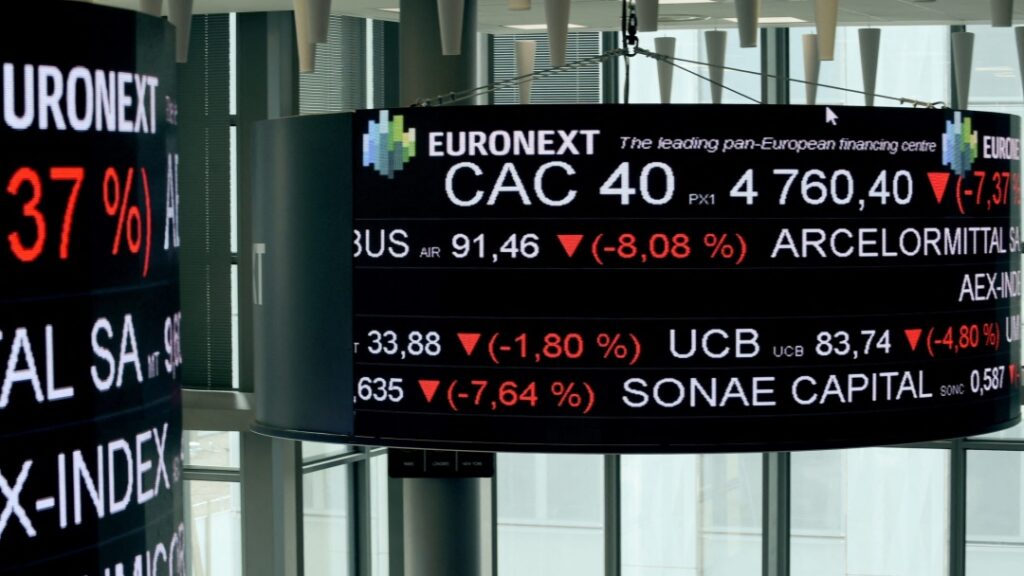
The global investment spotlight continues to shine on U.S. mega-cap tech stocks, yet a quieter but equally compelling opportunity is emerging in Europe. The CAC40, France’s flagship equity index and a core benchmark of the Eurozone, is increasingly positioned as a leveraged play on structural macro shifts expected to accelerate through 2026 — including a revival in Chinese consumption and Europe’s push toward industrial renewal.
As major global indices progress through what could be a multi-year bullish cycle, the CAC40 appears primed for a breakout from its consolidation phase, potentially setting new all-time highs.
Reassessing the Market: Why CAC40’s Bullish Structure Is Intact
The long-term investment case for CAC40 remains robust, supported by several powerful themes spanning luxury demand, industrial resurgence, and macro policy tailwinds.
1. Luxury’s Second Super-Cycle: A Renewed Wave of Chinese Purchasing Power
The CAC40 behaves almost like a global luxury ETF due to its heavyweight constituents — LVMH, Hermès, Kering, L’Oréal — which collectively represent a major portion of the index’s value.
In late 2025, early signals of recovery in China became evident. LVMH delivered its first positive revenue rebound in Mainland China in two years, fueled by rising spending from affluent consumers.
This marks the early stages of what analysts are calling “Luxury Super-Cycle 2.0.”
With China’s 2025 fiscal and monetary stimulus progressing into real economic activity, a resurgence in discretionary consumption could unfold — mirroring the post-pandemic “revenge spending” phenomenon.
Because luxury brands possess high operational leverage, even low-to-mid single-digit revenue growth from Chinese buyers can translate into amplified earnings expansion. This dynamic provides a broad and powerful uplift for the CAC40.

2. Industrial & Defense Mega-Cycle: Airbus and Safran Lead the Charge
Beyond luxury, the CAC40 offers deep exposure to Europe’s industrial and defense economy, anchored by giants such as Airbus SE (AIR.PA) and Safran SA (SAF.PA).
The aviation sector continues to face a dramatic supply-demand imbalance:
- Airlines and governments face a global aircraft shortage
- Airbus holds an order backlog exceeding 8,500 jets, equivalent to nearly 10 years of production
- Ongoing bottlenecks in engines, fuselage components, and avionics support persistent pricing power
Airbus benefits from not only firm aircraft demand but increasingly strong contractual terms as customers compete for limited production slots.
Meanwhile, Safran taps robust high-margin revenue streams linked to flight-hour service agreements — a structural cash flow engine sustained by global air-travel recovery.
Together, these industrial powerhouses anchor a significant portion of the CAC40’s long-term growth potential.
3. A Unique Composition: Luxury, Industry, and Energy in One Basket
The CAC40’s sector allocation is uniquely balanced across luxury, industrials, and energy — providing diversified cyclical exposure unmatched by typical European indices.
Current approximate index weights:
- Schneider Electric (~7.7%) — electrification, automation, AI-driven smart grid technology
- LVMH (~7.4%) — luxury bellwether
- Airbus (~6.6%) — aerospace and defense
- Safran (~6.1%) — engines, services, high-margin maintenance
- TotalEnergies (~6.0%) — diversified energy exposure
This blend transforms the CAC40 into a strategic macro portfolio — an integrated bet on luxury consumption recovery, defense spending, energy demand, aviation normalization, and Europe’s industrial renaissance.
Investors using platforms like Ultima Markets can trade CAC40 index CFDs with flexible leverage and tight spreads.
If you want to test CAC40 strategies risk-free, you can open a demo account or start trading with a real trading account.
4. Valuation Advantage & Global Rotation Tailwinds
Compared with U.S. equity markets such as the S&P 500 — often priced at elevated forward P/E ratios approaching 25–30x — the CAC40 trades at a far more attractive 14–16x forward earnings.
As global central banks, including the European Central Bank (ECB), move closer to rate-cut cycles in 2026, liquidity dynamics begin to favor undervalued equity markets.
The combination of:
- cheaper valuations,
- solid fundamentals,
- cyclical exposure, and
- rotation away from expensive U.S. tech
creates an appealing setup for global allocators who seek diversification and stronger risk-adjusted returns.
CAC40 Trading Outlook: Structurally Bullish with Breakout Potential
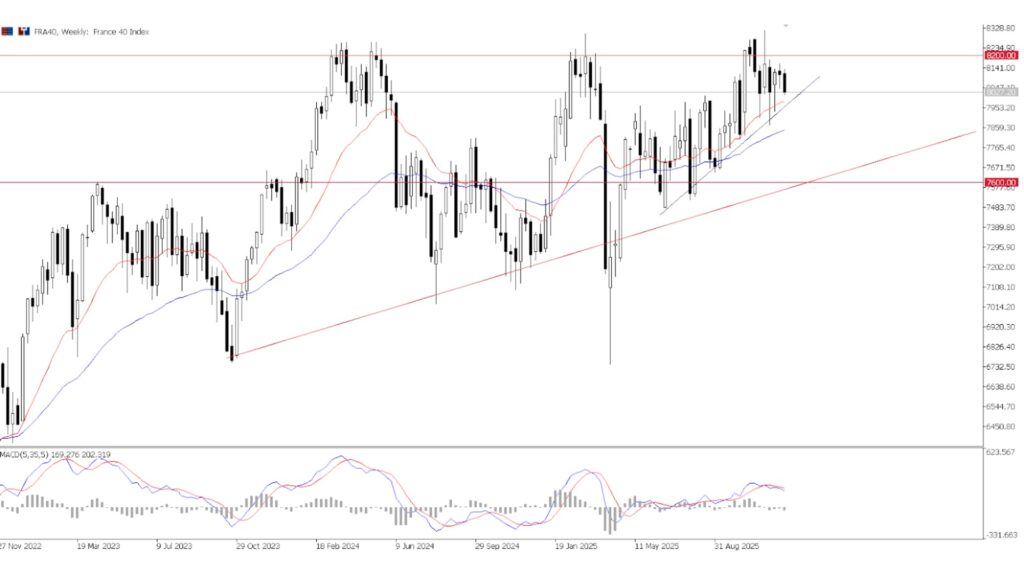
▲CAC40/FRA40, Weekly Chart
Technical positioning reinforces the fundamentally bullish narrative.
Recent price behavior shows:
- A strong base forming after months of consolidation
- Higher lows indicating steady accumulation
- Resistance compressing upward, suggesting readiness for breakout
These technical patterns align with long-term cyclical momentum across European equities.
Preferred Long Strategy for CAC40
Entry Strategy
- Enter on dips into support
- Or buy a confirmed breakout above the consolidation range
Support Levels to Watch
- 7,600 – 7,700: key demand zone supporting the current uptrend
- A break below 7,600 weakens the bullish case
- Below 7,200 → trend structure turns bearish
Upside Targets
- Initial target: 8,600
- Extended target: 8,900 – 9,000 assuming macro tailwinds continue
This setup benefits from the combination of luxury recovery, industrial momentum, and capital rotation into Europe.
Conclusion
The CAC40 stands at a compelling intersection of macroeconomic strength, sector diversification, and attractive valuation. With luxury seeing renewed demand from China, industrial leaders like Airbus and Safran entering multi-year growth cycles, and Europe gearing up for policy easing in 2026, the index may be significantly undervalued relative to its long-term potential.
If global liquidity continues rotating into value and cyclicals, the CAC40 could emerge as one of the strongest large-cap indices heading into 2026.
FAQ
1. What makes CAC40 different from other European indices?
The CAC40 uniquely blends luxury giants, industrial-defense leaders, and energy firms, giving it exposure to multiple high-growth macro themes.
2. Why is Chinese demand so important for CAC40?
Because companies like LVMH and Hermès rely heavily on Chinese luxury spending, even modest recoveries significantly boost CAC40 earnings.
3. Is CAC40 still undervalued?
Yes. Compared with U.S. benchmarks trading above 25x earnings, CAC40’s 14–16x forward P/E provides a valuation advantage.
4. Is now a good time to trade CAC40?
With technical indicators supportive and macro tailwinds strengthening, many traders view CAC40 as well-positioned for upside into 2026. You can practice trading with a demo account before committing real capital.
5. Can CAC40 reach new highs in 2026?
If luxury demand rebounds and industrial cycles remain strong, the index could break through its consolidation zone and aim for the 8,900–9,000 region.
This article represents the author’s personal views only and is for reference purposes. It does not constitute any professional advice.